
Written by: Mike Smalligan, Michigan Department of Natural Resources, Forest Stewardship Program and
Recipient of ACF’s 2025 Public Service Award for Excellence in Forestry.
Taken from the Seasonal Highlights & Happenings ACF Fall 2025 Newsletter.
Partnerships between public agencies and private companies or organizations are essential to helping 400,000 family forest
landowners in Michigan take good care of their woods. One example is how the Michigan Department of Natural Resources (DNR)
delivers the Forest Stewardship Program (FSP), a national program funded through USDA Forest Service to help family forest
landowners take good care of their woods. Every state forestry agency implements the program a little differently, and in Michigan we rely heavily on public - private partnerships to help landowners. Over the last nine years the Michigan Forest Stewardship Program has invested $125,237 of public tax dollars in the private sector Association of Consulting Foresters because ACF members are great partners in Michigan’s effort to help family forest landowners.
Public - private partnerships are important in Michigan for both philosophical and financial reasons. First, there is a very large
team of public agencies (USFS, NRCS, FSA, DNR, Extension, Conservation Districts, etc.) and private organizations (Michigan
Forest Association, Michigan Tree Farm Committee, land conservancies, consulting foresters, industry foresters, loggers, etc.)
that serve family forest landowners. These many partners can accomplish more with collaboration and synergy than by operating in isolation or competition. Working together to maximize our strengths and minimize our weaknesses benefits everyone, especially landowners who don’t really care about logos or turf battles. Second, no single organization has enough staff or funding to go alone in the massive task of helping several hundred thousand landowners. The Michigan DNR does not have dedicated funding sources for private forest landowners, so the Michigan Forest Stewardship Program has no choice but to value external partners. Even well-funded state agencies are fooling themselves if they think they don’t need to develop effective public - private partnerships. We should always be looking for opportunities to improve customer service and program delivery methods to better serve landowners.
The primary tool in the Forest Stewardship Program toolbox is connecting a landowner with a forester to develop a forest stewardship plan. Many states use government foresters to develop plans at little or no cost to landowners. Michigan once allowed conservation district foresters or DNR service foresters to develop plans, but that stopped around 15 years ago after ACF members complained about unfair competition. They were right. Now Michigan only uses private sector foresters to develop forest management plans for landowners, primarily to enroll in our two property tax reduction programs that require plans. This method works well, but it is not perfect. ACF values “a strong free enterprise system” but landowners rarely have adequate information to be informed consumers about an unusual product. Price and quality of forest stewardship plans are not correlated. Plans can be too long, too much boilerplate, and too expensive. Plans are not a perfect product, whether written by a government or private forester. But hopefully a plan helps a landowner get started on becoming a better steward of their woods.
ACF members write the most forest stewardship plans in Michigan and therefore are key partners for the Forest Stewardship
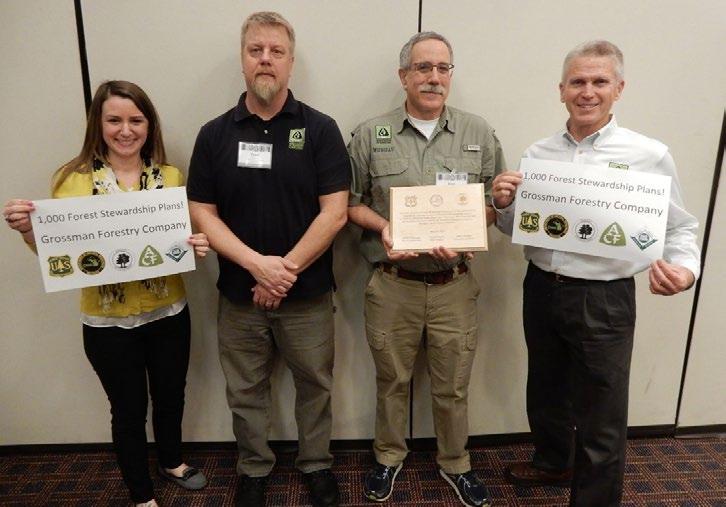
Program. Jerry Grossman of Grossman Forestry (recently merged with Green Timber Consulting Foresters) has been serving on
the Michigan FSP Advisory Committee since it started in 1991 giving common sense advice from a field forester’s perspective. Jerry and his staff have developed the most plans of any company in Michigan. We celebrated a major milestone in 2019 when Grossman Forestry Company developed their 1,000th forest stewardship plan. This accomplishment was also the basis for an award for Jerry Grossman from the Northeast-Midwest State Foresters Alliance as the 2019 Outstanding Cooperative Forest Management Forester. Jerry was the first private sector forester to win this award, which usually goes to a state agency service forester.
The Michigan chapter of Association of Consulting Foresters was a key partner on a grant-funded project called Forests for
Fish to showcase the connections between forests and water quality. The Michigan Forest Stewardship Program gave Michigan ACF $25,000 to increase membership and educate landowners about best management practices to protect water quality. My idea was
to give $1,000 to 25 candidates to attend a Practice of Consulting Foresters (PCF) class at a national ACF meeting. Rexx Janowiak of
Green Timber Consulting Forester was the Michigan chapter chair in 2017, and Rexx came up with a much better idea. Michigan
ACF used $24,936 to host a Practice of Consulting Foresters class in Michigan in 2018 that was attended by 71 candidates
from four states and another dozen ACF members. It was, at that time, the largest PCF class in the history of ACF.
One of best outcomes of federal funding to states through USFS State, Private & Tribal Forestry is that states learn from
each other and replicate good ideas. Cotton Randall at the Ohio Department of Natural Resources was also seeking to increase ACF membership in his state. Cotton and the Ohio ACF chapter hosted a Practice of Consulting Foresters class in Toledo in 2023 that surpassed the Michigan class and set a new ACF record. Ohio ACF hosted 97 foresters from 18 states at their PCF class! Michigan Forest Stewardship program contributed $15,000 towards this class and is thrilled that Ohio outdid our good work with even better work. Cotton now works for the USDA Forest Service as the Forest Stewardship Program manager for the 20 states in Region 9 and remains a good partner for ACF. I’d support his nomination for your 2026 Public Service Award.
After the success of working with ACF on Forests for Fish, the Michigan Forest Stewardship Program continued investing
in ACF with annual partnership grants from 2018 through 2025. These annual grants between $7,500 and $15,000 are used by Michigan ACF for advertising and supporting ACF members doing outreach, education and advocacy that is not usually compensated. Congressional budget cuts to USFS State, Private & Tribal Forestry are likely to force the Michigan Forest Stewardship Program to end this annual investment in ACF in fiscal year 2026.
Following the 2019 award to Grossman Forestry for developing 1,000 forest stewardship plans, the Michigan program
has continued to give annual Stewardship Forester awards to ACF members. The Michigan Stewardship Award is presented
each winter at the Michigan ACF meeting. Winners over the past six years include Hunter Fodor, Dean Francis, Jason Darling,
Brock VanOss, Jenilee Dean and Green Timber Consulting Foresters (Justin Miller, et al).
Numerous ACF members around the country helped Richard Carbonetti update the second edition of Introduction to
Consulting Forestry published by Society of American Foresters (SAF) in 2023. This book illustrates an effective partnership between ACF and SAF. It is also a great resource to recruit students and young foresters into consulting forestry. In 2024 the Michigan Forest Stewardship Program bought 100 copies in bulk from SAF for just $3,192 for Michigan ACF to share with students and new members. Every ACF chapter should buy this book in bulk to recruit new members and inspire students to become consulting foresters.
The Michigan Forest Stewardship Program is entirely funded by federal grants. Federal funds do not always have to pass through state agencies, so helping partners apply directly for federal funding is a great way to build capacity and better serve landowners.
The 2022 Inflation Reduction Act (IRA, Section 23002) appropriated $450 million in competitive grants to help small (<2,500
acres) and underserved (new, tribes, veterans, low income, high poverty regions) landowners access emerging markets
(carbon offsets, water funds, biodiversity credits, etc.). Michigan FSP applied for four IRA grants and won $10.5 million to better
serve small and undeserved landowners with Michigan Forest Association over the next five years. I wrote the first draft in 2024 of
ACF’s IRA proposal to access these federal “technical assistance” funds. ACF’s 750 members are the premier private sector providers of information and advice to family forest landowners nationwide. Justin Miller, Shannon McCabe and others on the ACF
leadership team developed that proposal into the $1 million project that USFS awarded to ACF in 2025.
The Michigan Forest Stewardship Program illustrates how government agencies and private consulting foresters can work together to better serve family forest landowners. Problems have been identified and solved together. Federal funding has been obtained
by the state agency and invested efficiently in private partners. But as with all things in government, effective public – private
partnerships depend upon good policy and consistent appropriations.
The current administration and Congress are reconsidering how the federal government invests in state agencies and private partners, for example, proposing the elimination of USFS State, Private & and Tribal Forestry, which is the funding source for all the public - private partnerships in Michigan FSP, earlier this year. While the recently passed appropriation package secures funding
through at least September 30, 2026 for many USDA and forestry-related programs, it falls short of long-term commitments, and
changes to Forest Stewardship Program funding will impact, possibly good or bad, how state agencies serve landowners and partner with ACF.
For ACF members and the state-private forestry community, this means that now is the moment to deepen the relationships you have with your state forestry agency, to highlight the value of your partnerships, and to help shape federal-state funding strategy
rather than simply react to it. It’s also an opportunity for ACF to continue to engage with policymakers—state and federal—on
how public-private forestry collaborations deliver value, why continuity of programs matters, and what funding model best supports family forest landowners and consulting foresters alike.
In closing, thank you ACF for your 2025 Public Service Award presented to me for the work we have done together to create an effective public - private partnership in Michigan. I greatly value the Association of Consulting Foresters, your staff Shannon and
Lucy, and the 750 ACF members nationwide. Keep up the good work!